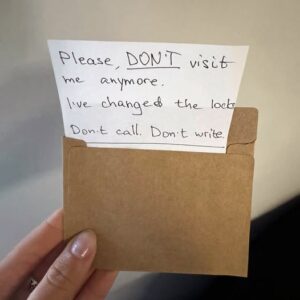
The hesitation hit me before I even stepped out of the car. My hands were still on the steering wheel when I heard faint singing spill out of the house—high, chaotic, unmistakably ten-year-old birthday energy.
I hadn’t been invited to the last two birthdays. I’d sent gifts from a distance—never sure if they landed well, never sure if I landed well anymore. But this time, Nadia had texted: You should come. If you want. That tiny invitation felt like a hand held out in a dark room. I wasn’t sure if it was genuine or a test, but I showed up anyway.
When I walked in, they were already mid-chorus around the cake. I froze at the door, not wanting to interrupt. Then my daughter spotted me and shouted over the singing:
“Mum! You missed the key again! Just like old times!”
Everyone laughed, but it wasn’t cruel. It was warm. It was familiar. Before I could react, she barreled toward me, arms thrown around my waist, smelling like vanilla frosting and apple juice. For the first time in months, something inside me unclenched.
The room was a beautiful mess—balloons hanging lopsided, paper crowns half-crushed, wrapping paper underfoot. My son, Isaac, gave me a stiff little wave from across the room before turning back to whatever game he was playing with his friends. Nadia glanced at me, gave a small nod—neutral, but not icy. For us, that was progress.
I stayed in the background while the presents were opened, my heart pounding like I was waiting for a verdict. When my daughter got to my gift—the illustrated journal with a tiny lock—she squealed and held it up.
“Look! Mum remembered I like to write!”
Everyone looked at her, then at me. Not pity. Not judgment. Just… acknowledgment. I didn’t realize how much I had missed hearing her call me “Mum” with that kind of pride.
The other parents avoided my eyes, pretending they hadn’t all chosen sides during the divorce. I didn’t care. I wasn’t there for them.
Across the room, Isaac stood alone by the punch bowl. Taller now. Shoulders broader. He looked like a kid who had been forced to grow up too fast. I approached him carefully.
“Hey, champ. Doing okay?”
“Yeah,” he mumbled. “It’s not that hot this year.”
“Last year was brutal,” I offered.
He gave a tiny shrug. “I guess.”
We lingered in that awkward space, both wanting to say something better but not sure how. When I mentioned his robotics achievement—something I’d only learned from quietly checking the school newsletter—he looked legitimately startled.
“It was semifinals,” he corrected softly.
“That’s amazing,” I said. And even though he didn’t smile, he didn’t walk away. That alone felt like a door cracking open.
After the chaos died down, I stayed to help tidy up. Nadia and I ended up shoulder-to-shoulder scraping frosting off plates. She handed me a trash bag and said, almost shy:
“You’re braver than me. Coming here… after everything. It’s not easy.”
“Being invited helped,” I replied.
She smirked. “Probably a peace offering. Or a trap.”
We both laughed—awkward, but human.
Then she said the one thing I didn’t expect: “Thanks for showing up.”
I didn’t know how much I needed to hear that until she said it.
Over the next weeks, I kept showing up in small ways. Dropping off library books for my daughter. Buying Isaac frozen yogurt after his study group. Letting Nadia know before I came by. Not asking permission—just being respectful. Being present.
Then one afternoon, out of nowhere, Nadia called.
“Can you watch the kids next weekend?” she asked. “My sister in Glasgow needs help with the baby.”
“Overnight?” I asked, stunned.
“Yeah. I mean… you’re their mum.”
That weekend felt like stepping back into a life I thought I’d forfeited. We made disastrous pancakes, played board games, laughed until our sides hurt. Isaac even introduced me to “Rocket League,” which I was catastrophically bad at, but he explained patiently. Patiently. Like he wanted to.
That night, long after my daughter was asleep, Isaac came downstairs.
“Can I ask you something?” he said, curling beside me on the couch.
“Anything.”
“Why’d you really leave?”
I felt that one like a punch. I took a long breath.
“Your mum and I stopped being good to each other. I thought leaving would make things easier for you two. Less fighting.”
“Didn’t feel easier,” he murmured.
“No,” I whispered. “I know it didn’t. And I’m sorry. I never left you. Not for a second. I just… messed up the execution.”
He didn’t answer. He just leaned his head onto my shoulder.
“Goodnight, Mum.”
I held onto that moment like a lifeline.
Things began to change after that. Slowly, then all at once.
I cheered at Isaac’s robotics competition. My daughter dedicated a school story to me: “Mum, who showed up again.” Nadia and I learned to talk like co-parents instead of enemies.
And then came the twist.
I got an email from a woman named Rachel. Her son was in my daughter’s class. Their kids were friends. She wanted to tell me something before it turned into gossip.
She and Nadia had been dating.
I stared at the screen, stunned—not by the relationship, but by being the last to know again. When I called Nadia about it, she sighed in guilt.
“I didn’t want to ruin what we were rebuilding,” she admitted.
“It doesn’t ruin anything,” I said. “I’m glad you’re happy. Just… don’t shut me out.”
She promised she wouldn’t. And surprisingly, she kept that promise.
Months passed. The kids spent every other weekend with me. We went camping and got rained out. We roasted marshmallows over a candle in the car and laughed until we cried. Rachel and I even reached a gentle, mutual understanding—no competition, no awkwardness, just two adults orbiting the same children with care.
And one rainy afternoon, my daughter climbed into the backseat holding a drawing: all four of us together, under a crooked rainbow.
“We’re still a family,” she said confidently. “Just… different.”
She was right.
Family isn’t defined by marriages or neat lines. It’s defined by showing up. By trying again. By choosing love even after you’ve failed.
So here’s to every parent learning to rebuild.
To every kid brave enough to forgive.
To every second chance quietly offered and loudly earned.
If this story moved you, share it. Comment. Send it to someone who needs to hear that it’s not too late—not if they’re willing to show up again.